

PTSD Self-Assessment for Mental Health Insight
Post-Traumatic Stress Disorder (PTSD) self-assessment. Complete and submit this form to receive your insight report.
Share on:
Disclaimer: This self-assessment tool provides educational mental health insights based on your responses and is not a substitute for professional evaluation. For a full assessment, please consult a licensed mental health provider in your state.
Reference: This questionnaire is based on the diagnostic criteria outlined in the Diagnostic and Statistical Manual of Mental Disorders, Fifth Edition (DSM-5), published by the American Psychiatric Association (APA).
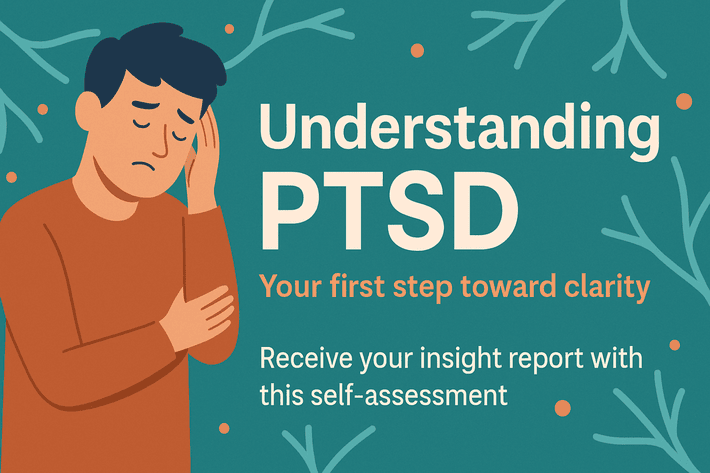
Wondering If You Have Post-Traumatic Stress Disorder (PTSD)? Start With This PTSD Self-Assessment.
Have you ever asked yourself, “Why do I feel constantly on edge?” or “Why do certain memories or situations make me feel like I’m back in a traumatic moment?” If so, you’re not alone. In fact, many people live with the lasting effects of trauma without realizing it. Fortunately, this self-assessment can help you gain clarity.
Understanding your mental health is the first step toward meaningful change. That’s why this PTSD Diagnostic Criteria Questionnaire—based on official DSM-5-TR standards—is designed to help you reflect on your experiences and begin the journey toward healing.
Why Take This PTSD Self-Assessment?
This clinically-informed questionnaire is a helpful tool to:
First, identify potential signs of PTSD (such as flashbacks, nightmares, avoidance, hypervigilance, or emotional numbness).
Next, reflect on how past trauma may still be impacting your daily functioning and emotional well-being.
Finally, prepare for a more informed conversation with a licensed mental health provider.
Moreover, taking time to explore your symptoms can be empowering. While it may feel overwhelming at first, reflecting on your experience is a courageous act—and an important step toward self-compassion.
How it works
- To begin, answer each question honestly based on your real-life experiences.
- Then, submit the form directly through this secure website.
- Shortly after, you’ll receive a personalized insight report summarizing PTSD-related symptoms.
Ready to Learn More About Your Reactions, Triggers, and Healing Process?
Take the next step toward clarity, recovery, and emotional resilience. Start today by completing the PTSD Self-Assessment Questionnaire.
Ultimately, your mental health journey is yours to shape—and this could be a powerful place to start.
Share on:
Conversation
Your voice matters. Discussions are moderated for civility.